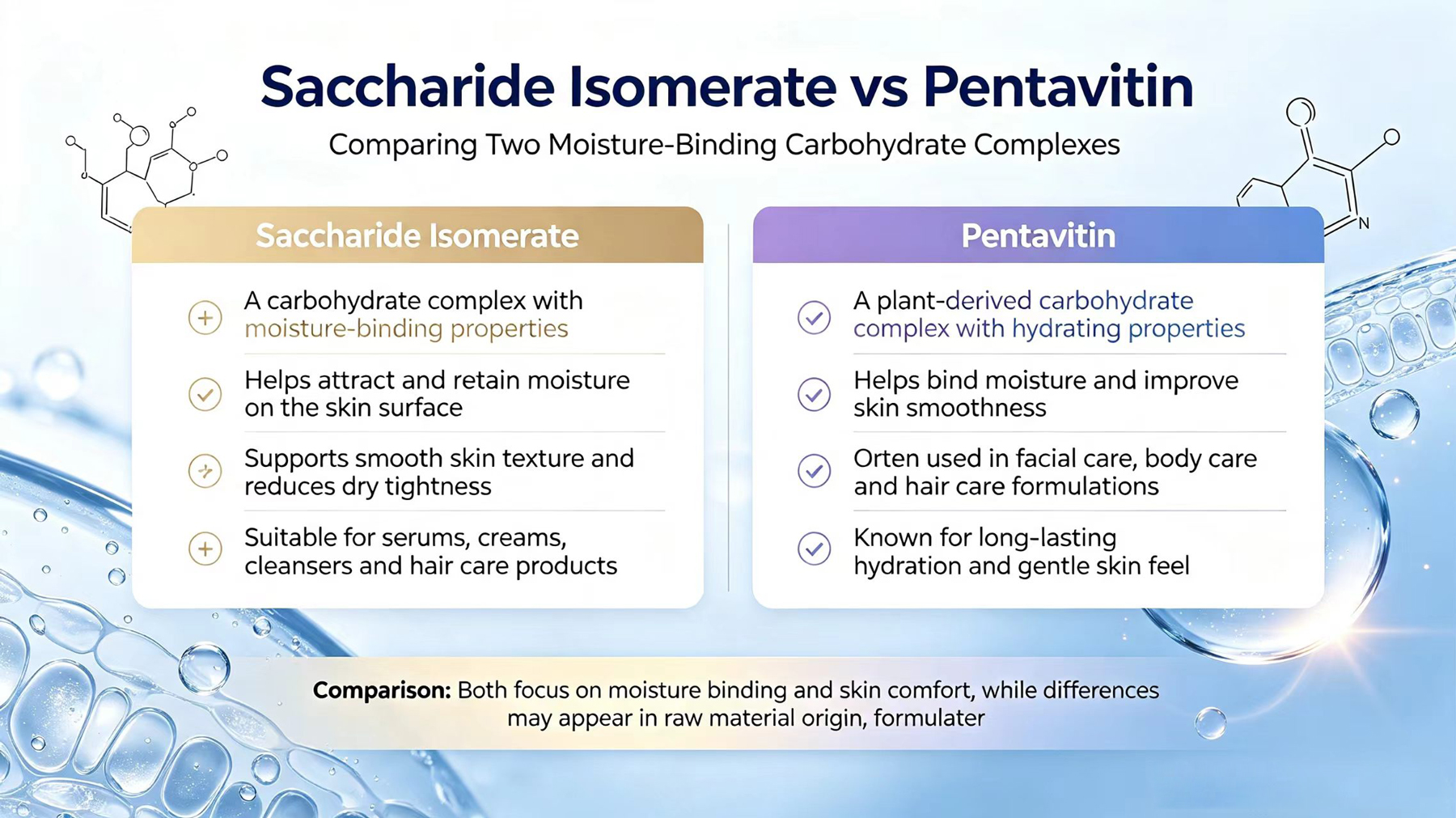
Saccharide Isomerate and Pentavitin are closely related—but they are not exactly the same thing. Pentavitin is a branded cosmetic ingredient based on Saccharide Isomerate, developed and marketed by DSM-Firmenich.
| Feature | Saccharide Isomerate | Pentavitin |
| Ingredient type | Cosmetic humectant | Branded Saccharide Isomerate complex/raw material |
| Origin | Carbohydrate/sugar-derived | Produced from plant-derived sugars and formulated as a standardized cosmetic ingredient |
| INCI | Saccharide Isomerate | Typically Saccharide Isomerate |
| Main function | Humectant, skin-conditioning agent | Long-lasting moisturizing and skin-conditioning |
| Mechanism | Attracts and retains water in the stratum corneum | Same basic mechanism, with emphasis on persistent binding to the skin |
| Skin affinity | High | High; a key selling point of Pentavitin |
| Barrier support | Helps maintain hydration and reduce dryness | Supports hydration and skin comfort through prolonged moisturization |
| Hair use | Hydration and conditioning | Hydration, conditioning and improved feel of dry hair/scalp |
| Commercial status | Generic ingredient designation | Proprietary commercial ingredient/brand |
| Formulation advantage | Depends on supplier and grade | Standardized, supplier-supported raw material with defined specifications |
| Best suited for | Moisturizers, serums, cleansers, hair products | Premium moisturizing skincare and haircare formulations |
1. The most important difference
Saccharide Isomerate is the ingredient name; Pentavitin is a commercial branded version/product based on that ingredient.
So it is somewhat like comparing:
Saccharide Isomerate = ingredient category
Pentavitin = specific commercial ingredient/raw material
Consequently, saying “Pentavitin vs. Saccharide Isomerate” is not quite the same as comparing two chemically unrelated actives.
2. Why Pentavitin is well known
Pentavitin is particularly marketed for its ability to provide long-lasting moisturization. Its carbohydrate components have strong affinity for the stratum corneum and can remain associated with the skin after application.
This makes it useful in products intended for:
- Dry and dehydrated skin
- Sensitive-feeling skin
- Moisturizing creams and lotions
- Facial serums
- Body care
- Hand creams
- Cleansers
- Shampoos and conditioners
- Scalp-care products
3. Hydration mechanism
Both rely primarily on humectant activity.
A simplified mechanism is:
Saccharide Isomerate → attracts water → associates with the stratum corneum → increases water availability → improves skin hydration → reduces the sensation of dryness
This is different from an occlusive such as petrolatum, which primarily forms a barrier that reduces transepidermal water loss.
4. Is Pentavitin more effective than generic Saccharide Isomerate?
Not necessarily.
This is an important formulation distinction.
A generic Saccharide Isomerate raw material can have different:
- Concentrations
- Purities
- Carrier systems
- Manufacturing specifications
- Recommended use levels
- Performance characteristics
Therefore, you should compare the actual supplier’s specification and clinical/instrumental data, rather than assuming that every Saccharide Isomerate material performs identically to Pentavitin.
Pentavitin’s major advantage is that it is a defined, commercially standardized material with supplier-specific performance data, rather than simply the name “Saccharide Isomerate.”
5. For hair care
Both can be useful when the goal is hydration rather than protein repair.
They may help:
- Improve hair moisture
- Reduce the feeling of dryness
- Improve softness
- Improve combability/conditioning
- Make hair feel smoother
- Support scalp hydration
However, they should not be described as directly repairing broken keratin bonds or permanently repairing damaged hair.
6. Which should a cosmetic formulator choose?
Choose Pentavitin when:
- You want a recognizable branded active.
- You need supplier-generated efficacy data.
- Marketing claims around long-lasting moisturization are important.
- You want a standardized commercial raw material.
Choose another Saccharide Isomerate raw material when:
- Cost optimization is important.
- You are developing a private-label or mass-market formulation.
- Your supplier provides adequate quality/performance data.
- You don’t need the Pentavitin brand story.
Bottom line
Pentavitin is best viewed as a proprietary commercial Saccharide Isomerate ingredient rather than a completely different active. The fundamental moisturizing chemistry is similar, while the major differences are supplier, standardization, formulation format, supporting data, specifications and branding.
If you’re evaluating them for a cosmetic formulation, the most useful comparison is actually Pentavitin vs. generic Saccharide Isomerate at equivalent active concentrations, including recommended dosage, INCI, solids content, preservation system, pH stability and cost per kilogram.
From cellsbio health technology co.,ltd
评论
发表评论