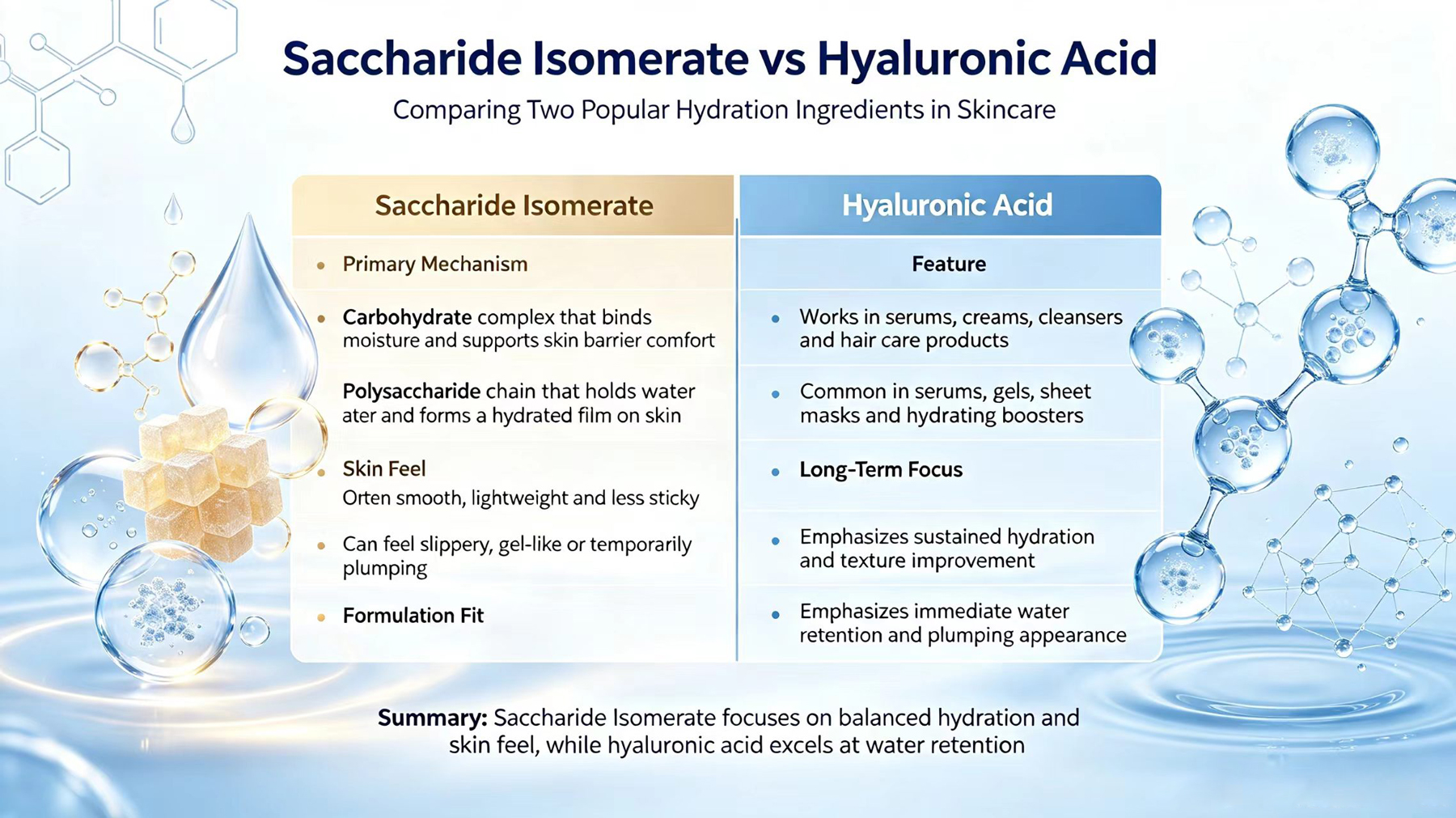
Saccharide Isomerate and Hyaluronic Acid (HA) are widely used cosmetic humectants, but they differ substantially in molecular structure, skin interaction, and formulation behavior.
| Feature | Saccharide Isomerate | Hyaluronic Acid |
| Nature | Mixture of small carbohydrate derivatives | Polysaccharide composed of repeating disaccharides |
| Primary role | Long-lasting moisturization and skin-conditioning | Hydration, water retention, film formation |
| Molecular size | Relatively small carbohydrate components | Molecular weight varies widely |
| Skin interaction | Can associate strongly with the stratum corneum | Mainly hydrates the skin surface; lower-MW forms may penetrate more deeply |
| Water binding | Excellent humectant | Excellent humectant |
| Persistence | Known for relatively persistent moisturization | Depends strongly on molecular weight and formulation |
| Skin feel | Generally light and non-tacky at appropriate levels | Can range from lightweight to viscous/tacky |
| Barrier support | Primarily through hydration and conditioning | Hydration can indirectly support barrier function |
| Film formation | Limited compared with HA | More pronounced, especially with high-MW HA |
| Fine-line appearance | Mainly through improved hydration | Hydration and temporary plumping can reduce the appearance of fine lines |
| Typical applications | Moisturizers, serums, cleansers, hair products | Serums, creams, masks, injectables/medical products |
| Best suited for | Persistent skin hydration and conditioning | Immediate hydration, plumping and surface water retention |
1. Mechanistic difference
Hyaluronic acid is a naturally occurring glycosaminoglycan. Its many carboxylate and hydroxyl groups allow it to bind substantial amounts of water. High-molecular-weight HA tends to remain primarily on the skin surface, where it forms a hydrated polymeric film.
Saccharide Isomerate is a carbohydrate-based humectant produced by rearranging sugars through an isomerization process. Its composition and behavior are different from HA: rather than forming the same type of large polymeric film, it is designed to provide persistent moisturization and skin conditioning, with particular affinity for the stratum corneum.
2. Which gives better hydration?
It depends on what “better” means.
Immediate surface hydration: Hyaluronic acid is excellent.
- Plumping effect: Hyaluronic acid, particularly appropriately selected molecular-weight grades, is often preferable.
- Long-lasting moisturization: Saccharide Isomerate can be particularly useful.
- Persistent stratum-corneum conditioning: Saccharide Isomerate has an advantage.
- Multi-weight hydration strategy: combining Hyaluronic acid grades can provide hydration at different levels of the skin surface.
3. Saccharide Isomerate’s major advantage
One of the most interesting characteristics of Saccharide Isomerate is its substantivity to the stratum corneum. It can remain associated with the skin and continue contributing to moisturization after application.
This makes it attractive for products intended to provide long-lasting hydration rather than simply an immediate “plumped” appearance.
4. Hyaluronic Acid’s major advantage
Hyaluronic acid is exceptionally versatile because different molecular-weight fractions can produce different cosmetic effects.
For example:
- High-MW HA: surface hydration and film formation
- Medium-MW HA: hydration and conditioning
- Low-MW HA: smaller polymer chains with different skin-interaction characteristics
- Crosslinked HA: greater persistence and gel-forming properties in specialized applications
Thus, “hyaluronic acid” is not one uniform material; its performance depends heavily on molecular weight, modification, concentration, and formulation.
5. Can they be used together?
Yes—and they can be complementary.
A formulation containing both can potentially provide:
Hyaluronic Acid → rapid water binding + surface hydration + plumping
Saccharide Isomerate → persistent moisturization + stratum-corneum conditioning
This combination is particularly logical in a hydrating serum, moisturizer, essence, or barrier-supporting formulation.
Bottom line
If the goal is immediate hydration and a plumping effect, Hyaluronic Acid is generally the stronger choice.
If the goal is persistent moisturization and prolonged skin conditioning, Saccharide Isomerate is particularly attractive.
For a sophisticated moisturizing formula, using both is often more advantageous than treating them as competing ingredients: HA provides the hydrated polymer network and immediate water-retention effect, while Saccharide Isomerate contributes longer-lasting carbohydrate-based moisturization.
From cellsbio health technology co.,ltd
评论
发表评论