Pyridoxal-5-Phosphate (PLP) is the active coenzyme form of vitamin B6, derived from the pyridine ring compounds collectively known as B6 vitamers. These include pyridoxine (PN), pyridoxal (PL), and pyridoxamine (PM), plus their phosphorylated forms (PNP, PLP, PMP). Of these, PLP has the highest biological activity and is the coenzyme that supports the majority of vitamin B6 functions.
Big picture (the key idea)
Vitamin B6 is a family of compounds.
Pyridoxal-5-Phosphate (PLP) is the biologically active coenzyme form that your body actually uses.
What counts as “Vitamin B6”?
Vitamin B6 includes three main forms (and their phosphorylated versions):
| Form | Abbreviation | Role |
| Pyridoxine | PN | Common supplement form |
| Pyridoxal | PL | Aldehyde form |
| Pyridoxamine | PM | Amine form |
| Pyridoxal-5-Phosphate | PLP / P-5-P | Active coenzyme |
When people say “vitamin B6” on a label, they usually mean pyridoxine (PN).
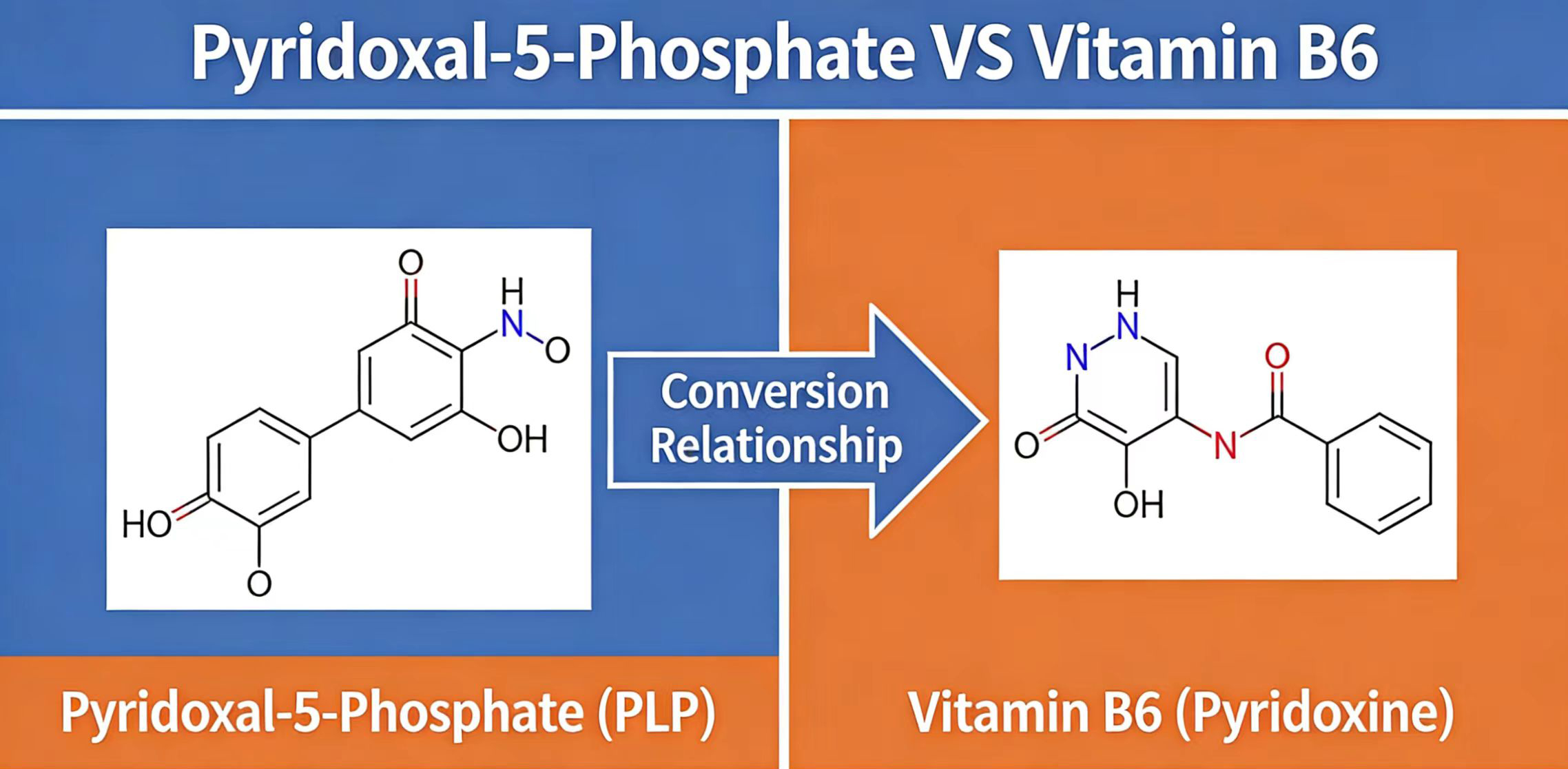
Core difference: Pyridoxal-5-Phosphate vs Vitamin B6 (pyridoxine)
1. Biological activity
Pyridoxal-5-Phosphate (P-5-P):
✅ Already active
Works immediately as a coenzyme
Vitamin B6 (pyridoxine):
❌ Inactive until converted
Must be converted in the liver → Pyridoxal-5-Phosphate
2. Metabolic conversion
Pyridoxine → Pyridoxal-5-Phosphate requires:
- Pyridoxine kinase
- Pyridox(am)ine-5′-phosphate oxidase
- Adequate riboflavin (B2), zinc, and magnesium
If these enzymes or cofactors are impaired, conversion can be inefficient.
3. Physiological functions
Only Pyridoxal-5-Phosphate directly participates in over 140 enzyme reactions, including:
- Amino acid metabolism (transamination, decarboxylation)
- Neurotransmitter synthesis (serotonin, dopamine, GABA, norepinephrine)
- Heme (hemoglobin) synthesis
- One-carbon metabolism
- Lipid metabolism (sphingolipid synthesis)
- Glycogen breakdown (glycogen phosphorylase)
Pyridoxine has no direct enzyme activity until converted.
4. Absorption & utilization
Pyridoxine:
Well absorbed, but relies on conversion efficiency
Absorbed as dephosphorylated PL → re-phosphorylated inside cells
Bypasses the main activation bottleneck
5. Safety & tolerance
Pyridoxine (high doses, long-term):
Associated with sensory neuropathy
Pyridoxal-5-Phosphate:
Generally better tolerated at equivalent functional doses
Lower risk of accumulation-related toxicity
Supplement comparison
| Feature | Pyridoxine (Vitamin B6) | Pyridoxal-5-Phosphate (PLP) |
| Active form | ❌ No | ✅ Yes |
| Needs liver activation | Yes | Minimal |
| Enzyme cofactor | Indirect | Direct |
| Neuropathy risk | Higher (high doses) | Lower |
| Cost | Cheaper | More expensive |
| Best for | General nutrition | Targeted / clinical use |
Which one should you choose?
Pyridoxine is usually fine if:
- You’re healthy
- Taking low–moderate doses
- Using it for general supplementation
Pyridoxal-5-Phosphate is often better if:
- You have liver issues
- You’re older
- You have high homocysteine
- You have neurological symptoms
- You’re taking high-dose B6
- You want predictable biochemical effects
Bottom line
- Vitamin B6 = a group of compounds
- Pyridoxal-5-Phosphate (PLP) = the active, usable form
- Your body ultimately cares about PLP, not pyridoxine
- From cellsbio health technology co.,ltd
评论
发表评论