Saccharide Isomerate is a carbohydrate-based cosmetic ingredient primarily used as a humectant and skin-conditioning agent. It is particularly valued for improving skin hydration and supporting the skin barrier. It is commonly associated with the trade name Pentavitin®, although the trade name refers to a particular commercial material rather than meaning that every Saccharide Isomerate raw material is necessarily identical.
PubChem lists Saccharide Isomerate under CAS 100843-69-4 and describes it as a dermatologic agent used to hydrate skin. It is not a single, simple small molecule with one discrete molecular structure; rather, the name represents a mixture of carbohydrate-derived components.
Recent Cosmetic Ingredient Review assessment concluded that Saccharide Isomerate is safe in cosmetics under the present practices of use and concentration evaluated by the panel.
1. Basic Information
| Property | Saccharide Isomerate |
| INCI name | Saccharide Isomerate |
| CAS No. | 100843-69-4 |
| Chemical class | Carbohydrate/saccharide derivative |
| Primary cosmetic function | Humectant, skin-conditioning agent |
| Main benefit | Long-lasting moisturization |
| Typical applications | Creams, lotions, serums, cleansers, masks, scalp products, hair care |
| Physical form | Usually supplied as an aqueous solution |
| Solubility | Highly water-compatible |
| Skin compatibility | Generally well tolerated |
| Common commercial association | Pentavitin® |
| Primary target | Stratum corneum and skin barrier |
2. Origin and Nature
Saccharide Isomerate is a sugar-derived material produced by chemical/enzymatic processing of carbohydrate feedstocks to generate a mixture of saccharide isomers.
The important distinction is that Saccharide Isomerate should not be regarded as one pure molecule in the same way that hyaluronic acid sodium salt or niacinamide can be represented by a relatively defined chemical structure.
Its functional behavior comes from carbohydrate structures containing numerous hydroxyl (-OH) groups. These groups interact strongly with water, giving the material its humectant properties.
Simplified concept
Carbohydrate source → controlled isomerization → saccharide mixture → purification/formulation → Saccharide Isomerate
This carbohydrate chemistry gives it a particularly useful combination of:
- water binding
- skin affinity
- Moisturization
- barrier-supporting properties
- relatively good formulation compatibility.
3. Chemical Structure
One of the most important points when studying Saccharide Isomerate is that it does not have a single conventional molecular structure.
PubChem specifically notes that it may not correspond to a discrete structure/CID, which reflects its nature as a mixture rather than a single defined compound.
The constituent carbohydrates contain multiple hydroxyl groups:
–OH
These hydroxyl groups form hydrogen bonds with water.
A simplified representation is:
Carbohydrate skeleton → multiple –OH groups → hydrogen bonding with H₂O → increased water retention
This is the fundamental chemical basis of its humectant activity.
4. Mechanism of Action
Saccharide Isomerate works primarily through water binding and interaction with the outermost layers of the skin.
Step 1 — Water attraction
Its numerous hydroxyl groups interact with water molecules through hydrogen bonding.
Step 2 — Humectant effect
Water is retained within the stratum corneum rather than being rapidly lost to the environment.
Step 3 — Surface hydration
The increased water content improves the hydration state of the corneocytes.
Step 4 — Barrier support
Better hydration can improve the physical properties of the stratum corneum and contribute to improved barrier performance.
Step 5 — Reduced dryness
The result is generally:
more hydrated skin → softer skin → reduced roughness → improved comfort
This is why Saccharide Isomerate is particularly useful in products designed for dry, dehydrated or barrier-stressed skin.
5. Why Saccharide Isomerate Is Different From Ordinary Humectants
Many conventional humectants—including glycerin, propanediol and sorbitol—mainly provide water-binding effects.
Saccharide Isomerate is interesting because carbohydrate-derived materials can have strong interactions with components of the stratum corneum, potentially helping hydration persist beyond the immediate application period.
This is the basis for the commercial positioning of certain Saccharide Isomerate products as longer-lasting moisturizers.
However, claims such as “72-hour hydration” should be interpreted as product-specific or supplier-specific substantiation, rather than assuming that every raw material containing the INCI name will necessarily deliver exactly the same result.
6. Hair and Scalp Applications
Saccharide Isomerate is not limited to facial skincare.
It can also be incorporated into:
- Shampoos
- Conditioners
- scalp serums
- hair masks
- leave-in conditioners
- anti-dandruff formulations
- moisturizing scalp treatments.
Potential hair benefits
Because hair fibers can become dry and rough, a carbohydrate humectant may help improve:
- hair hydration
- Softness
- Manageability
- Combability
- surface feel.
Scalp benefits
A hydrated scalp may experience:
- reduced dry feeling
- improved comfort
- reduced surface roughness
- better moisturization.
A recent clinical study specifically investigated Saccharide Isomerate in cosmetic scalp conditions, adding to the emerging evidence for this application.
7. Formulation Characteristics
Saccharide Isomerate is particularly convenient for aqueous cosmetic systems.
It is generally suitable for:
- Emulsions
- Gels
- Serums
- aqueous solutions
- Cleansers
- Masks
- Shampoos
- conditioners.
Because commercial Saccharide Isomerate products are frequently supplied as solutions, formulators should evaluate the actual active concentration of the supplied raw material, rather than treating the supplier solution as 100% Saccharide Isomerate.
This is especially important when comparing different commercial grades.
8. Compatibility With Other Ingredients
Saccharide Isomerate can generally be combined with many common moisturizing and barrier-supporting ingredients.
Particularly useful combinations
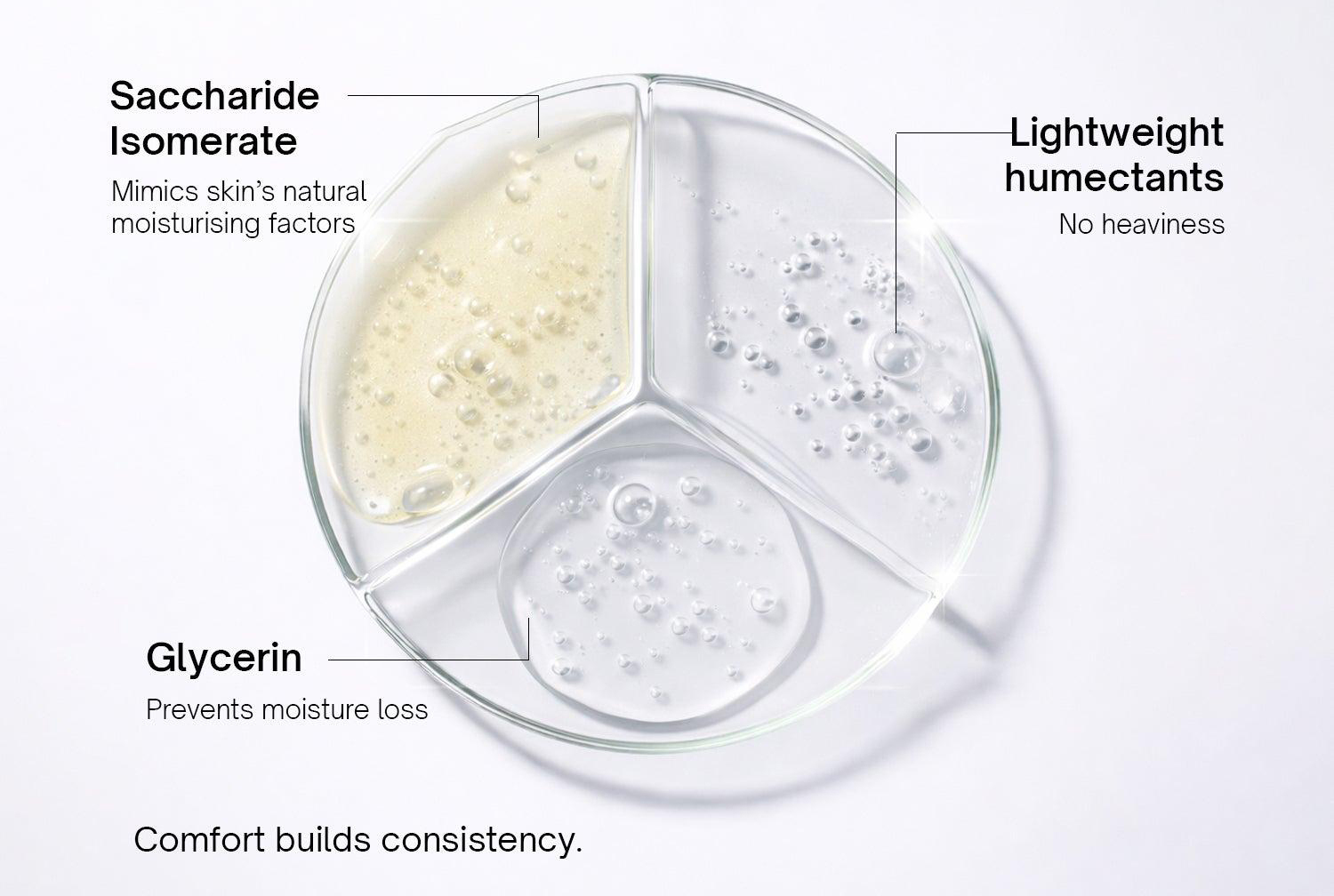
Saccharide Isomerate + Glycerin
Provides complementary humectant activity.
Saccharide Isomerate + Hyaluronic Acid
Combines carbohydrate-based hydration with high-molecular-weight/polymeric water retention.
Saccharide Isomerate + Panthenol
Provides moisturizing and skin-conditioning benefits.
Saccharide Isomerate + Ceramides
A particularly logical barrier-oriented combination:
Humectant + barrier lipids
Saccharide Isomerate + Niacinamide
Can be used in formulations targeting hydration, barrier support and overall skin appearance.
Saccharide Isomerate + Beta-Glucan
Provides another carbohydrate-based moisturizing/conditioning component.
Final Conclusion
Saccharide Isomerate is a plant-derived, sugar-based cosmetic active with strong humectant and skin-conditioning properties. Its distinguishing characteristic is its affinity for the carbohydrate-rich structures of the stratum corneum, which helps explain its prolonged water-binding behavior.
The ingredient is particularly valuable for dry skin, dehydrated skin, barrier-support products, moisturizers, serums, toners and scalp-care formulations. Clinical evidence supports improvements in hydration/barrier-related parameters and provides encouraging evidence for scalp applications, although the overall evidence base remains relatively small and some studies test combinations rather than Saccharide Isomerate alone.
From a formulation perspective, its greatest value is as a long-lasting hydration and barrier-support ingredient that complements glycerin, hyaluronic acid, panthenol, ceramides and other NMF components.
Its safety profile is favorable: the CIR Expert Panel has concluded that Saccharide Isomerate is safe in cosmetics under the reported conditions of use.
In short: Saccharide Isomerate is not simply a conventional humectant—it is a skin-affinitive carbohydrate complex whose primary cosmetic value lies in sustained hydration, improved skin feel, and support of the stratum-corneum barrier.
评论
发表评论