Pyridoxal-5-Phosphate (PLP) is the biologically active form of vitamin B₆, a water-soluble micronutrient essential for human and animal metabolism. Pyridoxal-5-Phosphate acts predominantly as a coenzyme in many enzymatic reactions, especially those involving amino acids. Its importance spans metabolism, neurotransmission, gene expression, immune function, and cellular signaling.
Chemical Structure and Properties
Chemical name: Pyridoxal-5-Phosphate
Molecular formula: C₈H₁₀NO₆P
Molar mass: 247.15 g/mol
Key Structural Features
- Pyridine ring: Provides electron-acceptor/donor capacity
- Aldehyde group at C4: Critical for forming Schiff base with amino groups
- Hydroxyl groups at C3 and C5: Influence hydrogen bonding and catalytic positioning
- Phosphate ester at C5′: Facilitates binding to enzymes and increases solubility
Physicochemical traits:
- Water-soluble
- Stable as phosphate salt under physiological conditions
- Exists in multiple tautomeric and ionized forms
Biosynthesis and Metabolism
1. Dietary Sources & Uptake
Vitamin B₆ exists in foods as:
- Pyridoxine (PN)
- Pyridoxal (PL)
- Pyridoxamine (PM) and their phosphorylated forms.
Dietary B₆ is absorbed primarily in the small intestine following dephosphorylation by alkaline phosphatases.
2. Conversion to Bioactive Form
In tissues (especially liver):
- Pyridoxal kinase (PDXK) phosphorylates PN/PL/PM to PNP/PLP/PNP.
- Pyridoxine phosphate oxidase (PNPO) oxidizes PNP and PMP to PLP.

3. Pyridoxal-5-Phosphate Trafficking & Turnover
- Pyridoxal-5-Phosphate is bound tightly to proteins to prevent degradation.
- Excess Pyridoxal-5-Phosphate is dephosphorylated and excreted in urine mainly as 4-pyridoxic acid.
- Tissue stores are limited; deficiency can develop within weeks without intake.
Biochemical Functions
Pyridoxal-5-Phosphate is chemical versatility underlies its role in numerous enzymes (termed PLP-dependent enzymes).
1. Amino Acid Metabolism
Most Pyridoxal-5-Phosphate-dependent reactions involve amino acids:
- Transamination: Transfers amino groups between α-amino acids and α-keto acids (e.g., AST, ALT).
- Decarboxylation: Produces neurotransmitters (GABA, serotonin, dopamine).
- Racemization: Converts enantiomers of amino acids.
- Elimination and substitution reactions: E.g., cystathionine β-synthase in sulfur metabolism.
Mechanistically, Pyridoxal-5-Phosphate forms a Schiff base (internal/external aldimine) with amino acids, stabilizing carbanionic intermediates.
Functional Roles in Physiology
1. Nervous System
Pyridoxal-5-Phosphate is required for:
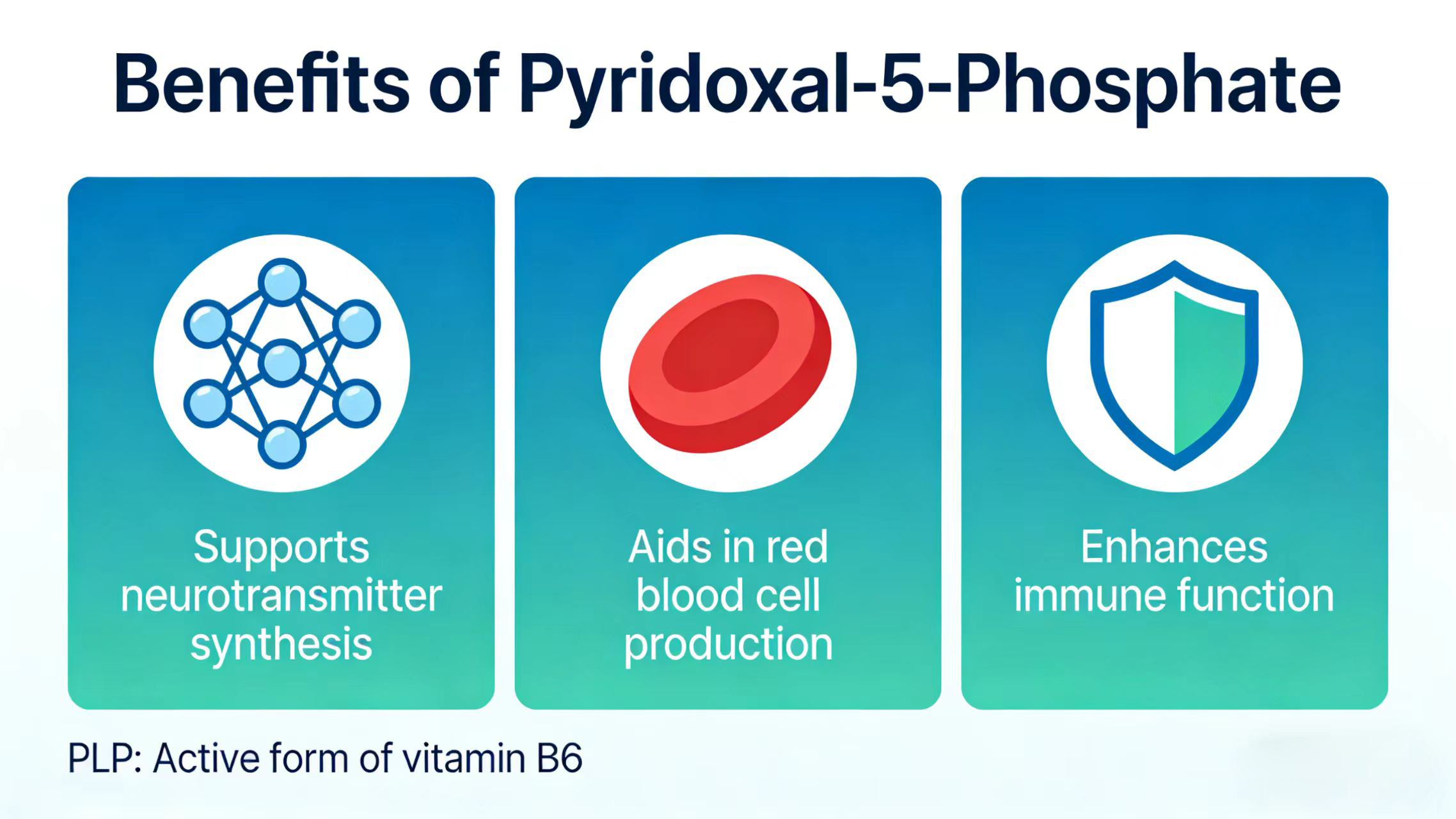
- Synthesis of neurotransmitters: GABA, serotonin, dopamine, norepinephrine.
- Modulation of neuronal excitability
- Myelin formation and repair
2. Immune System
- Supports lymphocyte proliferation and antibody production.
3. Hematopoiesis
- Essential for heme synthesis via δ-aminolevulinic acid (ALA) formation.
4. Gene Expression
- Pyridoxal-5-Phosphate influences gene regulatory mechanisms through cofactor roles in transcriptional enzymes.
5. Glucose & Lipid Metabolism
- Indirect roles via amino acid catabolism and gluconeogenesis.
Pyridoxal-5-Phosphate-Dependent Enzymes (Representative Examples)
| Enzyme | Pathway | Function |
| Alanine aminotransferase (ALT) | Transamination | Amino acid metabolism |
| Aspartate aminotransferase (AST) | Transamination | Interlinks amino acids & TCA cycle |
| Glutamate decarboxylase (GAD) | Neurotransmitter synthesis | Produces GABA |
| Cystathionine β-synthase | Sulfur amino acid metabolism | Homocysteine conversion |
| Serine hydroxymethyltransferase | One-carbon metabolism | Serine ⇌ glycine |
Mechanism of Action
Schiff Base Formation
Pyridoxal-5-Phosphate is aldehyde forms a Schiff base with an active-site lysine residue (internal aldimine). Upon substrate binding:
- Lysine is replaced → external aldimine forms with substrate.
- The cofactor stabilizes carbanionic intermediates via electron sink effect.
- Specific bond cleavage or rearrangement occurs.
Catalytic Versatility
Pyridoxal-5-Phosphate catalyzes:
- α-proton abstraction
- β- and γ-elimination
- Decarboxylation
- Transamination
Clinical Relevance
1. Deficiency
Causes:
- Poor intake, alcohol misuse, certain medications (e.g., isoniazid)
- Genetic defects in metabolism (PNPO deficiency)
Symptoms:
- Peripheral neuropathy
- Seizures
- Anemia
- Dermatitis
- Cognitive impairment
Laboratory findings:
- Low plasma Pyridoxal-5-Phosphate levels
- Elevated homocysteine
2. Toxicity
High supplemental doses can cause:
- Sensory neuropathy
- Numbness and gait disturbances
Rare at dietary levels.
3. Therapeutic Roles
Pyridoxal-5-Phosphate/B₆ supplementation is used for:
- Pyridoxine-dependent epilepsy
- Certain metabolic disorders
- Pre-eclampsia/premenstrual syndrome (evidence mixed)
4. Drug Interactions
Drugs that interfere with Pyridoxal-5-Phosphate metabolism:
- Isoniazid
- Hydralazine
- Penicillamine
→ May precipitate deficiency.
Laboratory Measurement & Biomarkers
1. Pyridoxal-5-Phosphate Quantification
- HPLC or LC–MS/MS
- Plasma Pyridoxal-5-Phosphate is the standard biomarker for B₆ status.
2. Functional Markers
- Elevated homocysteine
- Elevated cystathionine
- Kynurenine pathway perturbations
Genetic and Molecular Biology Aspects
1. Enzyme Deficiencies
- PNPO deficiency: Neonatal seizures due to inability to synthesize Pyridoxal-5-Phosphate.
- Aminotransferase mutations: Affect amino acid metabolism.
2. Regulation of Pyridoxal-5-Phosphate Levels
- Feedback at enzyme expression and transporter levels.
3. Pyridoxal-5-Phosphate in Gene Regulation
- Emerging evidence: Pyridoxal-5-Phosphate influences gene expression via coenzyme roles in transcription regulators.
Research Frontiers
1. Pyridoxal-5-Phosphate in Disease Mechanisms
- Neurological disorders (Parkinson’s, Alzheimer’s)
- Immune dysregulation
- Cancer metabolism
2. Pyridoxal-5-Phosphate-Analog Drug Design
- Design of Pyridoxal-5-Phosphate-mimetic inhibitors targeting Pyridoxal-5-Phosphate-dependent enzymes (e.g., in pathogens).
3. Structural Biology
- High-resolution studies of Pyridoxal-5-Phosphate binding and conformational dynamics.
4. Microbiome Interactions
- Bacterial synthesis and competition for Pyridoxal-5-Phosphate influence host metabolism.
Summary
Pyridoxal-5-Phosphate is a central metabolic cofactor with indispensable roles in amino acid biochemistry, neurotransmitter synthesis, energy metabolism, and cellular homeostasis. Understanding its biology is vital for clinical nutrition, metabolic disease, drug interactions, and molecular medicine.
Suggested Further Reading
- Reviews on Pyridoxal-5-Phosphate enzymology
- Textbooks on vitamin B₆ metabolism
- Primary research on Pyridoxal-5-Phosphate-dependent enzyme mechanisms
If you’d like, I can go deeper into enzyme mechanisms (with reaction diagrams), clinical case studies, or metabolic pathway mapping based on Pyridoxal-5-Phosphate function.
From cellsbio health technology co.,ltd
评论
发表评论