Saccharide Isomerate is a naturally derived carbohydrate complex widely used in cosmetics and personal care formulations as a powerful humectant, skin-conditioning agent, barrier-support ingredient, and long-lasting moisturizer. It is especially valued in products designed for dry skin, sensitive skin, anti-aging care, and barrier repair because of its ability to bind strongly to the skin surface and maintain hydration.
1. Application in Skin Care Products
(1) Moisturizers and Hydrating Creams
The primary application of Saccharide Isomerate is as a long-lasting moisturizing ingredient.
Functions:
- Attracts and binds water molecules from the environment and deeper skin layers
- Reduces transepidermal water loss (TEWL)
- Maintains skin softness and suppleness
- Provides hydration that persists after product application
Common products:
- Face creams
- Moisturizing lotions
- Hydrating gels
- Body lotions
- Hand creams
Suitable for:
- Dry skin
- Dehydrated skin
- Rough skin
- Mature skin
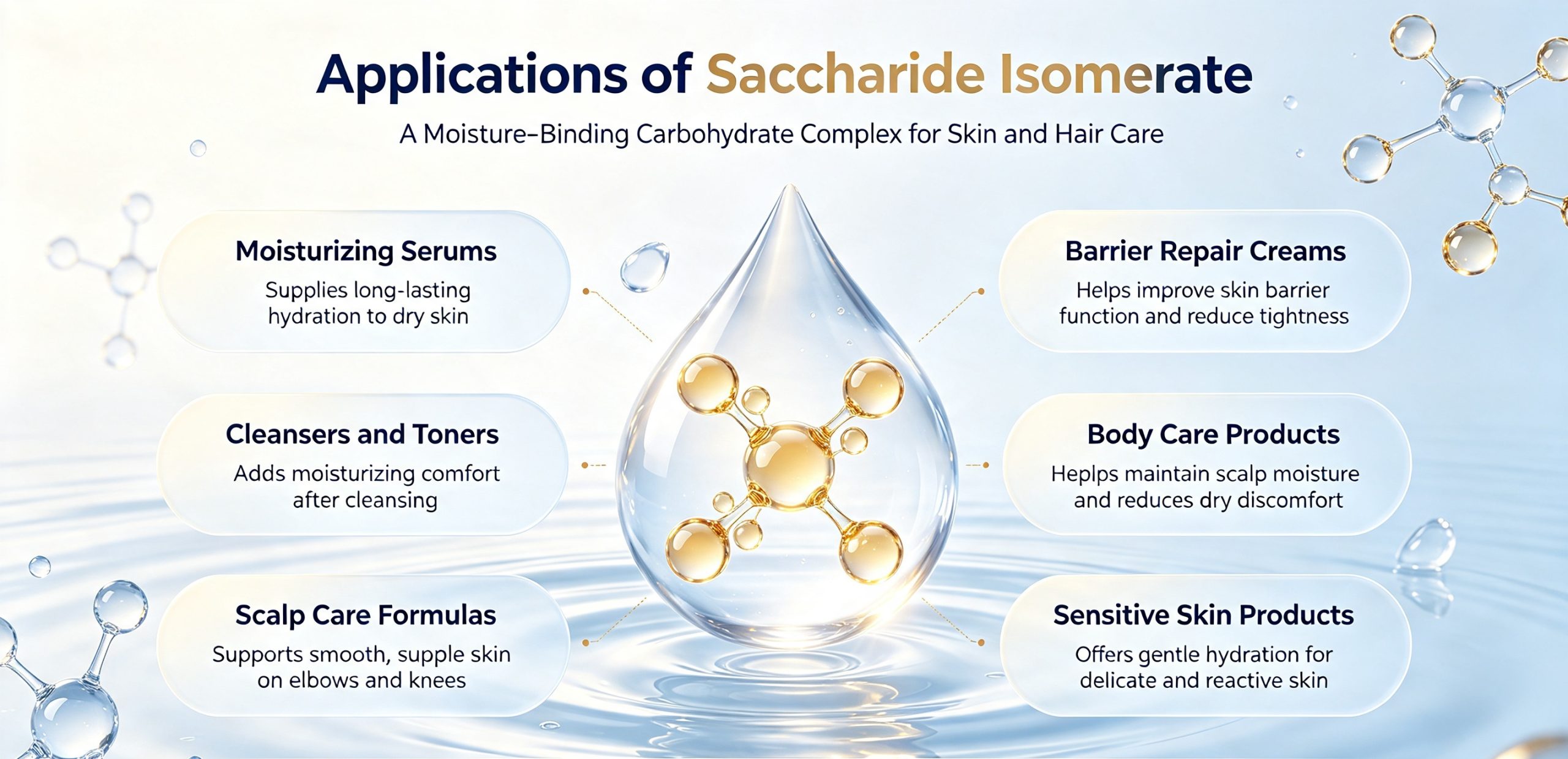
2. Barrier Repair and Skin Protection Products
Saccharide Isomerate is frequently incorporated into skin barrier repair formulations.
Mechanism:
(1) Saccharide Isomerate attaches to keratin proteins in the stratum corneum.
(2) It forms a water-retaining layer on the skin surface.
(3) It improves the organization of the skin’s natural moisturizing factors (NMF).
(4) It supports recovery of a compromised skin barrier.
Applications:
- Barrier repair creams
- Post-procedure skincare products
- Sensitive skin formulations
- Products for irritated or stressed skin
It is often combined with:
- Ceramides
- Cholesterol
- Fatty acids
- Panthenol
- Hyaluronic acid
- Beta-glucan
3. Anti-Aging Skincare Applications
Although Saccharide Isomerate is not a direct collagen stimulant, it supports anti-aging effects through hydration and barrier improvement.
Benefits:
- Reduces the appearance of fine dehydration lines
- Improves skin smoothness
- Enhances skin elasticity by maintaining water content
- Creates a plumper, healthier appearance
Used in:
- Anti-wrinkle creams
- Firming serums
- Neck creams
- Eye creams
Common combinations:
- Retinol/retinal products
- Peptides
- Niacinamide
- Vitamin C derivatives
4. Application in Facial Serums and Essences
Saccharide Isomerate is popular in lightweight hydration products because it provides moisture without a greasy feeling.
Used in:
- Hydrating serums
- Essence products
- Ampoules
- Facial mists
Advantages:
- Water-soluble
- Compatible with many active ingredients
- Provides immediate and sustained hydration
- Suitable for layered skincare routines
5. Application in Sensitive Skin Products
Saccharide Isomerate is considered a gentle ingredient and is frequently used in sensitive skin formulations.
Applications:
- Redness-relief products
- Skin-calming creams
- Baby skincare products
- Hypoallergenic cosmetics
Why it is useful:
- Helps reduce dryness-related discomfort
- Supports barrier function
- Does not usually cause irritation
- Works well in fragrance-free formulations
6. Application in Eye Care Products
The delicate eye area benefits from Saccharide Isomerate because dehydration can make fine lines more visible.
Functions:
- Improves moisture retention around eyes
- Reduces the appearance of dry fine lines
- Smooths skin texture
Used in:
- Eye creams
- Eye gels
- Under-eye serums
7. Application in Hair Care Products
Saccharide Isomerate is also used in hair and scalp formulations.
Hair benefits:
- Improves hair hydration
- Reduces dryness and rough texture
- Enhances softness and manageability
- Helps maintain scalp moisture balance
Applications:
- Shampoos
- Conditioners
- Hair masks
- Leave-in treatments
- Scalp care products
8. Application in Cleansing Products
Saccharide Isomerate can be added to cleansers to reduce the drying effects of surfactants.
Used in:
- Facial cleansers
- Body washes
- Gentle cleansing foams
Benefits:
- Maintains skin hydration after washing
- Reduces tightness after cleansing
- Improves cleanser mildness
9. Application in Sunscreen Products
Saccharide Isomerate is sometimes incorporated into sunscreen formulations to improve skin comfort.
Roles:
- Counteracts dryness caused by UV filters
- Improves sensory feel
- Supports skin hydration during sun exposure
Used in:
- Sunscreen lotions
- Daily SPF moisturizers
- After-sun products
10. Application in Professional and Medical Skincare
Because of its barrier-supporting properties, Saccharide Isomerate is used in products designed for compromised skin.
Potential applications:
- Post-laser skincare
- Post-peeling care
- Dermatological moisturizers
- Products for dry skin conditions
11. Formulation Applications
Typical Concentration Range
| Product Type | Typical Usage Level |
| Facial moisturizer | 1–5% |
| Serum | 1–5% |
| Eye cream | 1–3% |
| Cleanser | 0.5–3% |
| Hair products | 1–5% |
(Actual levels depend on supplier specifications and formulation goals.)
12. Compatibility With Other Cosmetic Ingredients
Saccharide Isomerate generally has excellent compatibility.
Common combinations:
| Ingredient | Purpose of Combination |
| Hyaluronic acid | Multi-level hydration |
| Glycerin | Enhanced humectant effect |
| Ceramides | Barrier repair |
| Niacinamide | Barrier strengthening and brightening |
| Peptides | Anti-aging formulations |
| Panthenol | Soothing and hydration |
| Ectoin | Stress protection |
| Polyglutamic acid | Surface hydration |
13. Advantages in Cosmetic Formulation
Key advantages:
✅ Long-lasting moisturizing effect
✅ Strong skin affinity
✅ Lightweight texture
✅ Suitable for sensitive skin
✅ Compatible with many actives
✅ Helps improve skin feel
✅ Plant-derived origin (depending on production source)
14. Limitations
Despite its benefits, Saccharide Isomerate has limitations:
- It is mainly a hydration and barrier-support ingredient, not a strong anti-aging active by itself.
- It does not directly increase collagen production.
- It works best as part of a multi-active formulation.
- Effects depend on concentration and overall product design.
Summary
Saccharide Isomerate is a versatile cosmetic ingredient primarily used for deep hydration, moisture retention, skin barrier reinforcement, and improving skin comfort. Its strongest applications are in moisturizers, serums, barrier repair products, sensitive skin formulations, eye care, and hair care products. Because of its excellent skin compatibility and long-lasting hydration properties, it has become a valuable ingredient in modern hydrating, anti-aging, and dermatological skincare formulations.
From cellsbio health co.,ltd
评论
发表评论