Acetyl Octapeptide-3/SNAP-8 is a synthetic peptide used in cosmetic formulations as a topical anti-wrinkle ingredient. It is an acetylated octapeptide derived from the N-terminal end of the protein SNAP-25, which is involved in neurotransmitter release through the SNARE complex.
1. Chemical Structure of Acetyl Octapeptide-3 (SNAP-8)
Acetyl Octapeptide-3/SNAP-8 is a synthetic peptide composed of eight amino acids, designed as an extended analog of Acetyl Hexapeptide-8. It mimics a fragment of the SNAP-25 protein involved in the SNARE complex responsible for neurotransmitter release.
Molecular Composition
- Peptide Type: Synthetic oligopeptide
- Number of amino acids: 8
- Amino-acid sequence: Ac-Glu-Glu-Met-Gln-Arg-Arg-Ala-Asp-NH₂
Where:
- Ac- = N-terminal acetyl group
- -NH₂ = C-terminal amide group
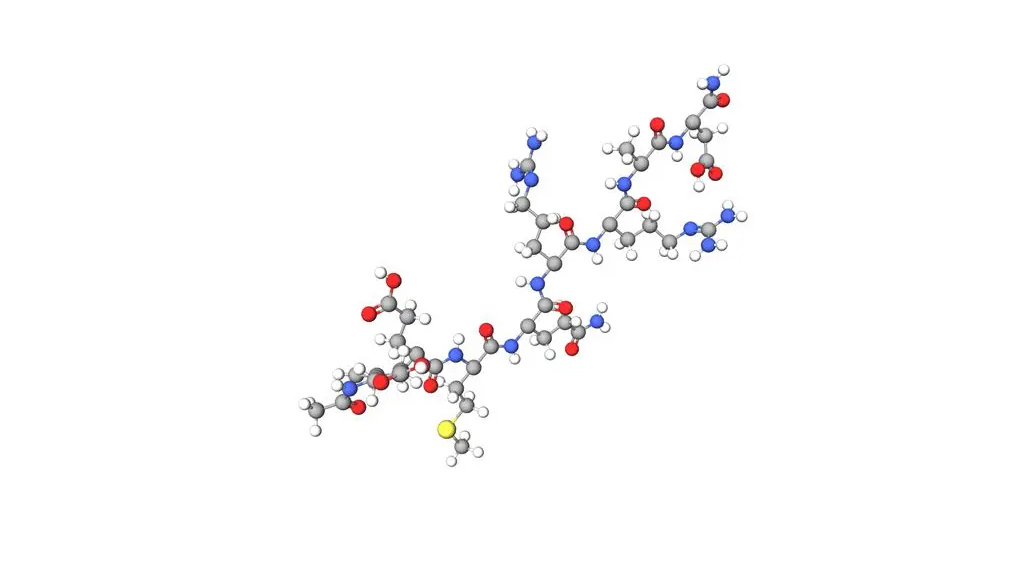
Structural Characteristics
1. N-terminal acetylation
- Increases stability and resistance to enzymatic degradation.
2. C-terminal amidation
- Neutralizes the terminal charge and improves bioactivity.
3. Linear peptide chain
- Acetyl Octapeptide-3/SNAP-8 is not cyclic; it is a linear oligopeptide.
4. SNAP-25 mimic fragment
- The sequence corresponds to part of the N-terminal domain of SNAP-25, enabling interference with SNARE complex formation.
Simplified Structural Representation
Ac–Glu–Glu–Met–Gln–Arg–Arg–Ala–Asp–NH2
This peptide fragment competes with SNAP-25 during SNARE complex assembly, reducing neurotransmitter release and thereby relaxing facial muscle contraction.
2. Physical Properties of Acetyl Octapeptide-3/SNAP-8
| Property | Description |
| Molecular formula | C₄₁H₇₀N₁₆O₁₆S |
| Molecular weight | ~1075.2 g/mol |
| Appearance | White to off-white powder |
| Solubility | Highly soluble in water |
| Odor | Odorless or very faint |
| pH stability | Stable around pH 4–7 |
| Thermal stability | Stable at low–moderate temperatures; degrades at high heat |
| Charge | Slightly negative/neutral depending on pH |
| Hydrophilicity | Highly hydrophilic |
3. Physicochemical Characteristics Relevant to Cosmetics
(1) Water-soluble peptide
Allows easy incorporation into:
- serums
- creams
- gel formulations
(2) Large molecular size
Molecular weight >1000 Da
Limited skin penetration
Often delivered using:
- liposomes
- nano-carriers
- peptide boosters
3. Biologically active peptide fragment
Acts as a competitive inhibitor in the SNARE protein complex to reduce muscle contraction.
4. Stability Characteristics
| Factor | Stability |
| Light | Generally stable |
| Heat | Sensitive to high temperatures |
| Enzymes | Protected somewhat by acetylation |
| pH | Optimal stability pH 4–7 |
For cosmetic formulations:
- Best added during cool-down phase (<40 °C).

Summary
Acetyl Octapeptide-3/SNAP-8 is an acetylated linear octapeptide derived from a fragment of SNAP-25.
Its structure (Ac-Glu-Glu-Met-Gln-Arg-Arg-Ala-Asp-NH₂) enables it to interfere with the SNARE complex, reducing neurotransmitter release and facial muscle contraction. Physically, it is a water-soluble, hydrophilic peptide powder with a molecular weight of ~1075 Da, commonly used in anti-wrinkle cosmetic formulations.
If you want, I can also explain:
- 3D molecular structure of Acetyl Octapeptide-3/SNAP-8
- Detailed physicochemical parameters (logP, isoelectric point, stability constants)
- Comparison of Acetyl Octapeptide-3/SNAP-8 vs Argireline molecular structure (very useful for cosmetic R&D).
评论
发表评论