Ribonucleic Acid and Deoxyribonucleic Acid are both nucleic acids that carry genetic information, but they have several key differences in structure, function, and role within cells:
1. Structure:
Deoxyribonucleic Acid (DNA):
- Deoxyribonucleic Acid is a double-stranded helix composed of two long chains of nucleotides.
- It contains the sugar deoxyribose (hence the “deoxy” in its name), which lacks one oxygen atom compared to ribose in RNA.
- The nitrogenous bases in DNA are adenine (A), thymine (T), cytosine (C), and guanine (G). Adenine pairs with thymine, and cytosine pairs with guanine.
- Deoxyribonucleic Acid is usually located in the cell’s nucleus (in eukaryotes) or in the cell membrane (in prokaryotes).
Ribonucleic Acid (RNA):
- Ribonucleic Acid is typically single-stranded and consists of a single chain of nucleotides.
- The sugar in Ribonucleic Acid is ribose, which has an extra hydroxyl group (-OH) on the second carbon atom compared to deoxyribose.
- The nitrogenous bases in Ribonucleic Acid are adenine (A), uracil (U), cytosine (C), and guanine (G). In RNA, uracil replaces thymine.
- Ribonucleic Acid is found in both the nucleus and the cytoplasm in eukaryotic cells.
2. Function:
Deoxyribonucleic Acid (DNA):
- Deoxyribonucleic Acid serves as the genetic blueprint for all living organisms. It stores the instructions for building proteins and governs cellular functions.
- Deoxyribonucleic Acid is responsible for replication (copying itself) during cell division, ensuring genetic continuity.
- It also functions in transcription (where an Ribonucleic Acid copy of a gene is made) and storage of genetic information.
Ribonucleic Acid (RNA):
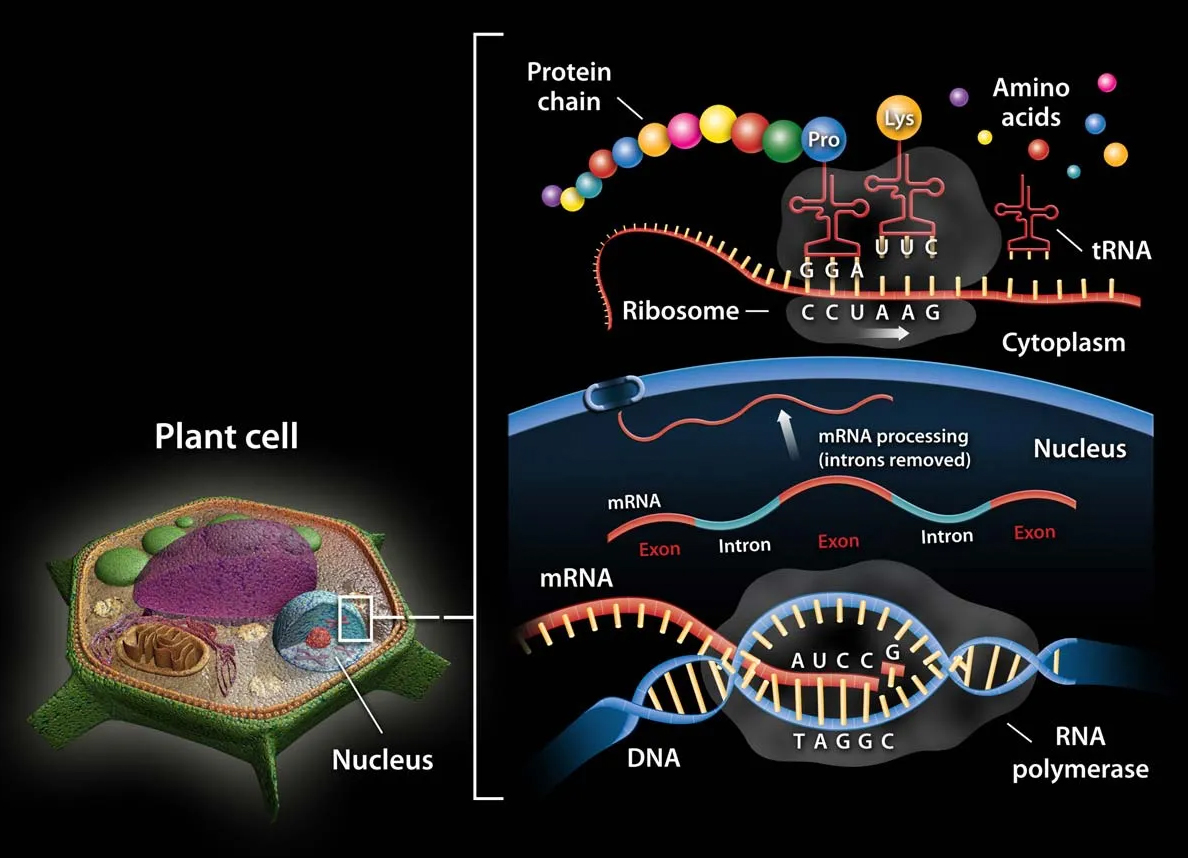
- Ribonucleic Acid plays a critical role in protein synthesis through processes such as transcription and translation.
- Messenger Ribonucleic Acid (mRNA) carries genetic information from Deoxyribonucleic Acid to ribosomes, where proteins are synthesized.
- Transfer Ribonucleic Acid (tRNA) helps decode mRNA into a specific sequence of amino acids to form proteins.
- Ribosomal Ribonucleic Acid (rRNA) is a key structural and functional component of ribosomes.
- There are also other forms of Ribonucleic Acid like small nuclear Ribonucleic Acid (snRNA) involved in RNA splicing and microRNA (miRNA) that regulates gene expression.
3. Stability:
Deoxyribonucleic Acid (DNA):
- Deoxyribonucleic Acid is more stable than Ribonucleic Acid due to its double-stranded structure and the lack of the extra hydroxyl group on the sugar. This stability is critical for long-term storage of genetic information.
Ribonucleic Acid (RNA):
- Ribonucleic Acid is less stable than Deoxyribonucleic Acid because of the extra -OH group on ribose, which makes it more prone to hydrolysis. As a result, Ribonucleic Acid has a shorter lifespan in the cell.
4. Location:
Deoxyribonucleic Acid (DNA):
- In eukaryotes, Deoxyribonucleic Acid is primarily located in the nucleus, with small amounts found in mitochondria (and in plant cells, chloroplasts).
- In prokaryotes, Deoxyribonucleic Acid is located in the nucleoid region, an area of the cell without a membrane.
Ribonucleic Acid (RNA):
- Ribonucleic Acid is produced in the nucleus (in eukaryotes) and then often travels to the cytoplasm to participate in protein synthesis. Some Ribonucleic Acid, like mRNA, is involved in the nucleus-cytoplasm transport.
5. Types and Roles:
Deoxyribonucleic Acid (DNA):
- Chromosomal Deoxyribonucleic Acid is the primary genetic material.
- Mitochondrial Deoxyribonucleic Acid (in animals and plants) and plastid Deoxyribonucleic Acid (in plants) also exist, although in smaller quantities.
Ribonucleic Acid (RNA):
- mRNA (messenger Ribonucleic Acid): carries genetic information from DNA to the ribosomes for protein synthesis.
- tRNA (transfer Ribonucleic Acid): helps decode mRNA into amino acids during translation.
- rRNA (ribosomal Ribonucleic Acid): makes up the ribosomes and helps catalyze the formation of peptide bonds during protein synthesis.
- Other types: regulatory RNAs like siRNA (small interfering Ribonucleic Acid) and miRNA (microRNA) control gene expression.
6. Key Differences in Summary:
| Feature | Deoxyribonucleic Acid | Ribonucleic Acid |
| Strands | Double-stranded | Single-stranded |
| Sugar | Deoxyribose (lacks one oxygen atom) | Ribose (has an extra hydroxyl group) |
| Bases | A, T, C, G (Thymine pairs with Adenine) | A, U, C, G (Uracil replaces Thymine) |
| Function | Stores genetic information, replication | Translates genetic info into proteins |
| Stability | More stable | Less stable |
| Location | Nucleus (in eukaryotes), cytoplasm (in prokaryotes) | Nucleus and cytoplasm |
Both Deoxyribonucleic Acid and Ribonucleic Acid are essential for life, working together in the process of gene expression, where Deoxyribonucleic Acid provides the instructions and RNA executes them in the form of proteins.
评论
发表评论